

Here are some books I’ve been delighting in recently – Sussex Coils & Loops by Paul Holman (strange folklore as strange and beautiful poetry as strange and beautiful and wondrous ritual, this is something new) / Beyond The Mauve Zone by Kenneth Grant (the more I re-read this baffling, infuriating and fascinating work, the more I’m convinced Twin Peaks: The Return is based on it) / The Secret History of the Universe by Jonathan Black (intelligent erudition revealing all the quantum physicists were wizards) / The Language of Gerard Manley Hopkins by James Milroy (I’m slowly becoming obsessed with Hopkins, can barely believe he was Victorian) / The Hermetic Order of the Golden Dawn: Magic Arts and the Occult Revival by Felix John Taylor (gorgeous book that foregrounds the art in the Magical Arts) / The Rite of Spring: The Music of Modernity by Gillian Moore (the bravery of making something new) / The Function of the Orgasm by Wilhelm Reich (George Harrison to Jung’s McCartney and Freud’s Lennon, Reich was simultaneously a bit of a crank and excitingly far-sighted, which is quite the trick to pull off. Pioneer of Sex-Pol – basically the world would be a cooler place if everyone had more sex.) / A Lover’s Discourse by Roland Barthes (for you, who has known love).
Those are all proper professional books, but if you fancy something a little more amateur (it’s the chaotic future, I’ve seen it) then I’ve made fifty copies of the book pictured here. Prodigiosa! Free. I have about eight left to give out.
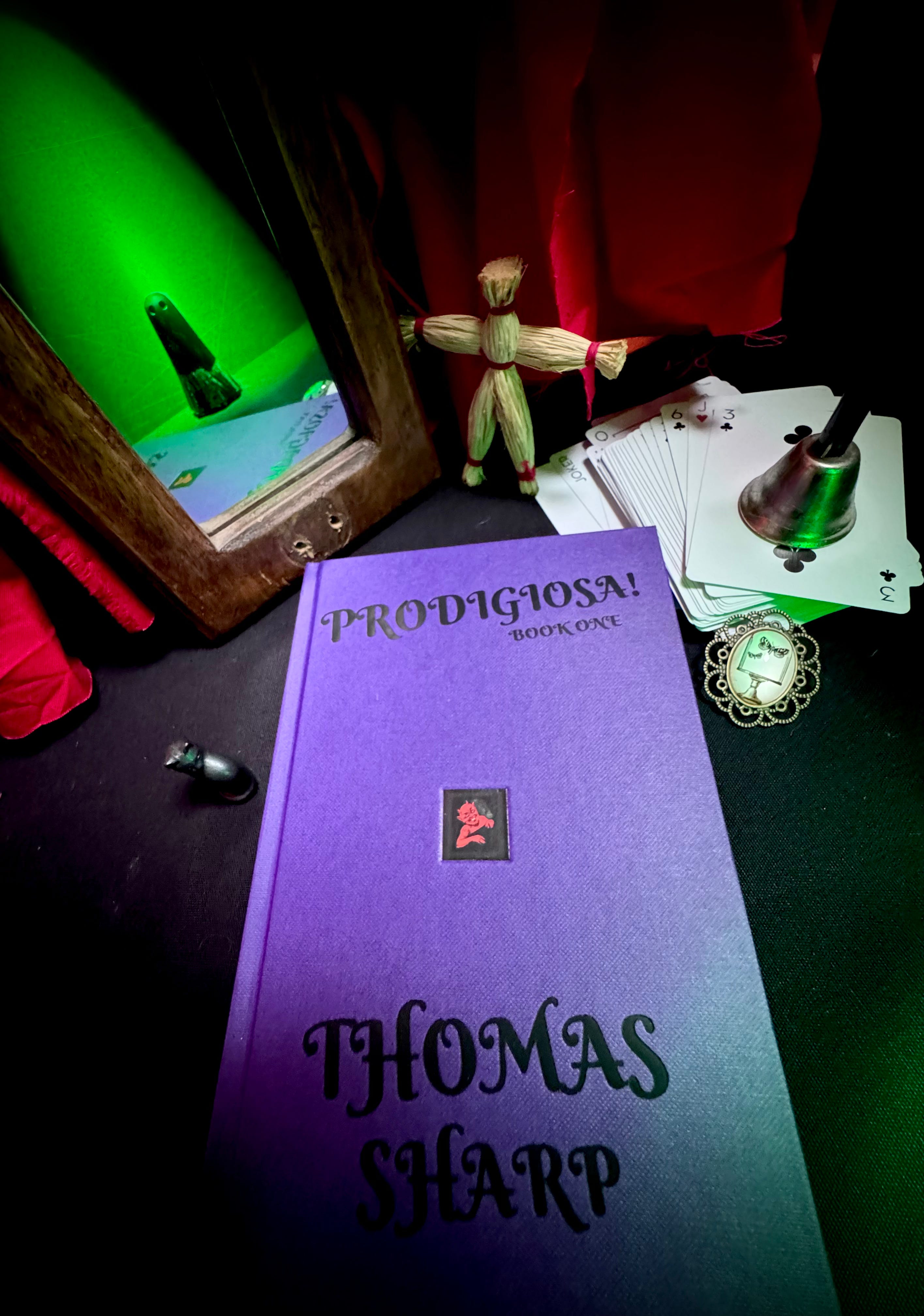
It’s the first 20,000 words of a 100,000 word novel and it is most definitely a work-in-progress.
It’s sort of poetry rather than prose in many places and it’s about a boy who can discover forgotten rooms in every building he enters. He’s the ‘Creative Child’ from my collection ‘Black ribbon’ which one reviewer, as you’ll see below, called ‘too Secret Garden via Hammer Horror.’
There’s a black cat, a magician, some sorrow, Charlotte Brontë and a chapter written in the voice of Enid Blyton. Ask me NOW for yours today. Otherwise I will have wasted the hour it took me to get the angles correct for the ghost in the mirror in that picture.
There’s an extract from Prodigiosa! at the bottom of this letter.
So yes, my work has begun to get reviews from people I don’t know. This is a new experience for me.
The Idol of the Marketplace and Black ribbon were reviewed together in Gramarye, which is the Chichester Centre for Fairy Tales, Fantasy and Speculative Fiction’s journal for folklore, fairy tales and fantasy.
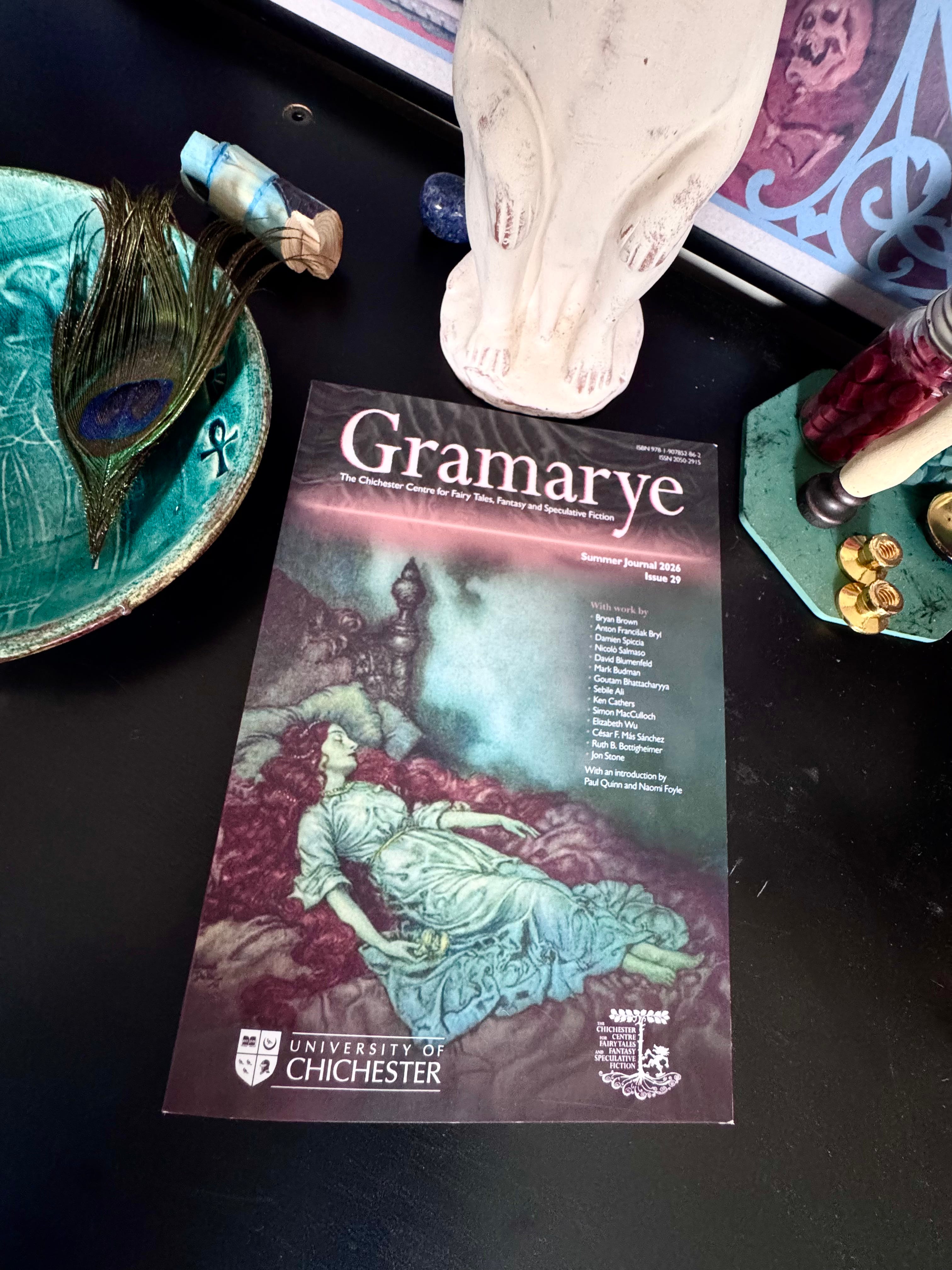
As a literary veteran of ONE (1) magazine review, polishes imaginary medals, … I now realise that reviews aren’t for the writer, but as guides to potential readers. I’ll quote below – criticisms too – and you can tell me if you fancy a copy of Black ribbon. If so I’ll post you one. (All copies of The Idol of the Marketplace have gone I’m afraid.)
The reviewer is Stray Bulletin.
“These two elegant, self-published hardback volumes are so different in character I might never have guessed they’re by the same author. They also resist simplistic framing.”
“[In Black ribbon] the poems have a gothic flavour: brooding, bleak, elaborately detailed, each page like a filigreed wrought-iron gate. The Idol of the Marketplace is a much more shifty affair, a sort of novella-in-verse.”
“What unites both titles is a commitment to dense, often thorny language with frequent unpredictable turns. Strange images and allusions adorn the poems like berry clusters, some just out of reach, others suggesting a motif.”
[Of Black ribbon]
“It can get a little too Secret Garden via Hammer Horror at times, especially when roses, skulls and blood enter the mix - a little twee, or teenage witch. But there’s a self-consciousness - a teasingness, even - behind the earnest excess that keeps things lively, and certainly made me want to spend more time unpicking the knots.”
“This loose thematic coherence helps sustain the charged, New Weird atmosphere - at times, Idol reads like a rolling thundercloud of prophetic pondering.”
“It’s worth noting as well that both titles are impeccably edited and typeset, and that Sharp is in full control of the effects he is deploying. If there are aspects I found overly relentless or ornamental, it doesn’t take away from the clarity of vision which informs each book - these are not collections of loosely linked pieces but fastidiously structured literary works that demonstrate a fertile imaginative range.”
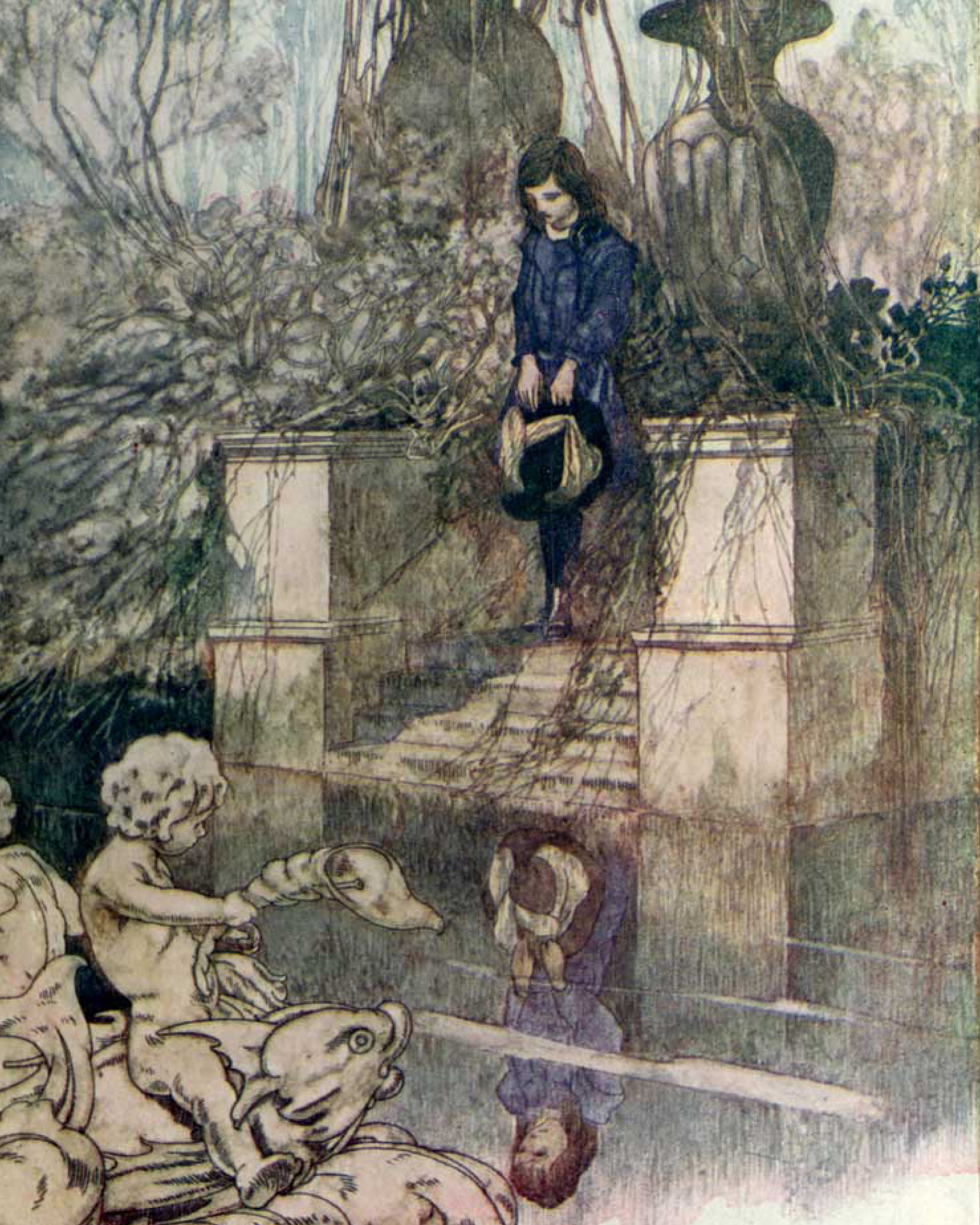
I don’t think Black ribbon is gothic actually, more Symbolist. In that the symbols in the poems aren’t so much manifestations of the dark unconscious but are Platonic glimmers of an unknown and unknowable realm.
And my, slightly feverish, reading into Symbolism continues.
(Reminder, I’m founding a Symbolist salon, called Black ribbon, in London at the beginning of next year – just twelve monthly meetings. Email me if you want in – yes@thepoetryofitall.com. To come you must be floridly magic. Which you are, everyone says so.)
In my reading on the topic of Symbolism, I recently discovered a couple of essays from 1890 - 1893 by Gabriel-Albert Aurier, a forgotten member of the 27 club. Extract from his writing below.
“After having proclaimed the omnipotence of scientific observation and deduction for eighty years with childlike enthusiasm, and after asserting that for its lenses and scalpels there did not exist a single mystery, the nineteenth century at last seems to perceive that its efforts have been in vain, and its boast puerile. Man is still walking about in the midst of the same enigmas, in the same formidable unknown, which has become even more obscure and disconcerting since its habitual neglect.”
“They realise that this experimental science, of which they were so proud, is a thousand times less certain than the most bizarre theogony, the maddest metaphysical reverie, the least acceptable poet’s dream, and they have a presentiment that this haughty science which they proudly used to call “positive” may perhaps be only a science of what is relative, of appearances, of “shadows” as Plato said, and that they themselves have nothing to put on old Olympus.”
“To love is the only way to penetrate into a thing. To understand God, one must love Him; to understand a woman, one must love her; understanding is in proportion to love. The only means, thus, to understand a work of art is to become the lover of it. This is possible, as the work is a being that has a soul and manifests this by a language that one can learn.”
His fixation on the negative aspects of science is timely, though 130 years past. The reason I think Symbolism deserves a new flowering is that one could quite easily swap out the descriptions of science in the extracts above, for the eroding and delirious adoption of LLMs – led by those who believe reality, or even just language, can be described, constrained, controlled by predictive algorithms.
And yet, and yet, Alex Sarll makes a serious point and criticism of the potential of Symbolism in another insightful review of Black ribbon on Goodreads.
It’s worth reading the whole thing, but I do like this line “[Symbolism’s] great drawback as a mode is that it can so easily tip into feeling like a sphinx without a secret.”
I’ve always loved that Austin, Texas’s unofficial tagline is ‘Keep Austin Weird’. So I’m very proud that some of my work has been collected by Francis the Curator in Curia Arcanum's House of Curiosities in Austin.
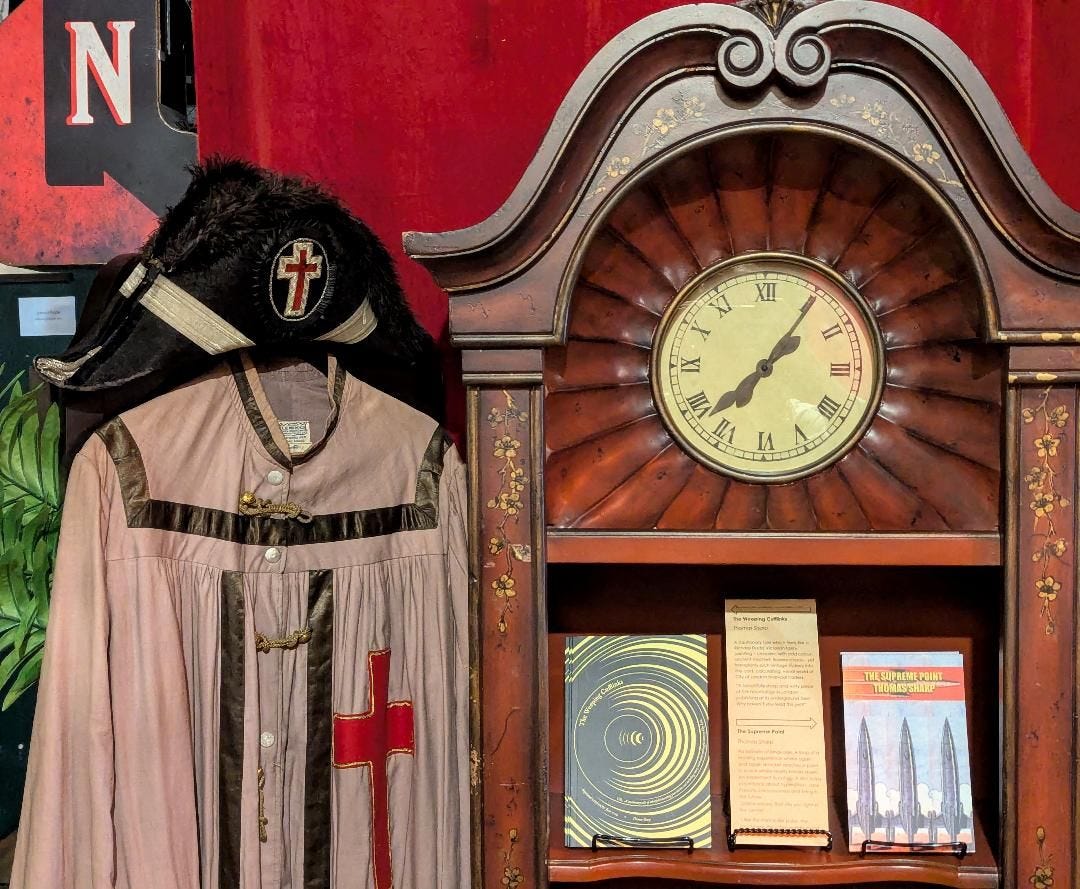
A copy of The Idyllegy by me and Will of Margaret is displayed in a case (alongside rare Crowleyana and letters by my guy Joséphin Péladan) …
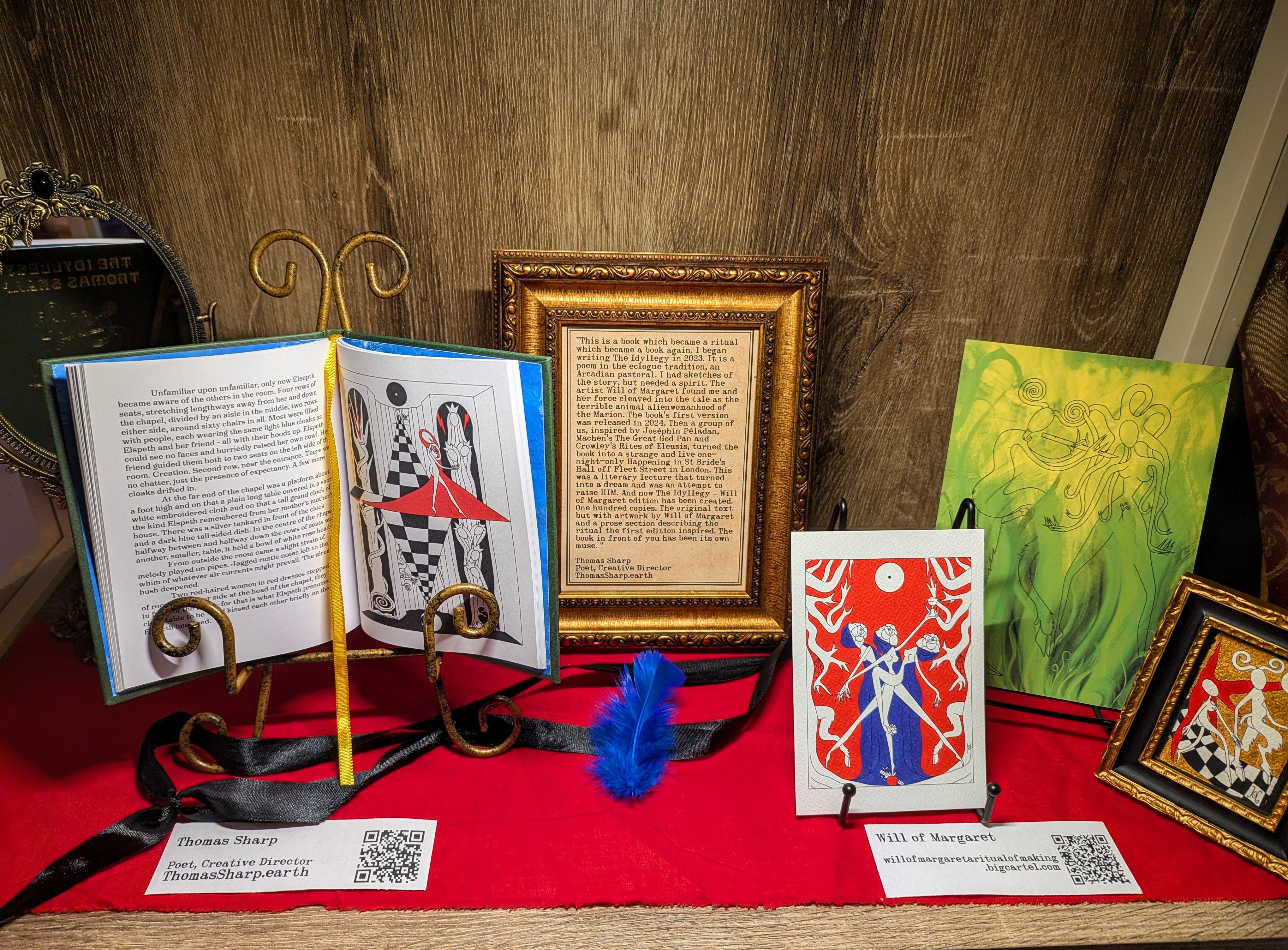
… and my poems The Weeping Cufflinks and The Supreme Point appear next to a Templar’s robe.
My next book project – out towards the end of November with pre-orders opening at the beginning of October – will be a re-release of my folk-horror teen romance Jack and Jill.
I am tumbling-down-a-hill-on-fly-agaric-giddy about this one.
It’s being designed by Stop, Look and Listen studio with whom I co-created the recent Bank of England magick spell and our every-four-years-giant-faery-ring-around-the-City-of-London. They are very cool.
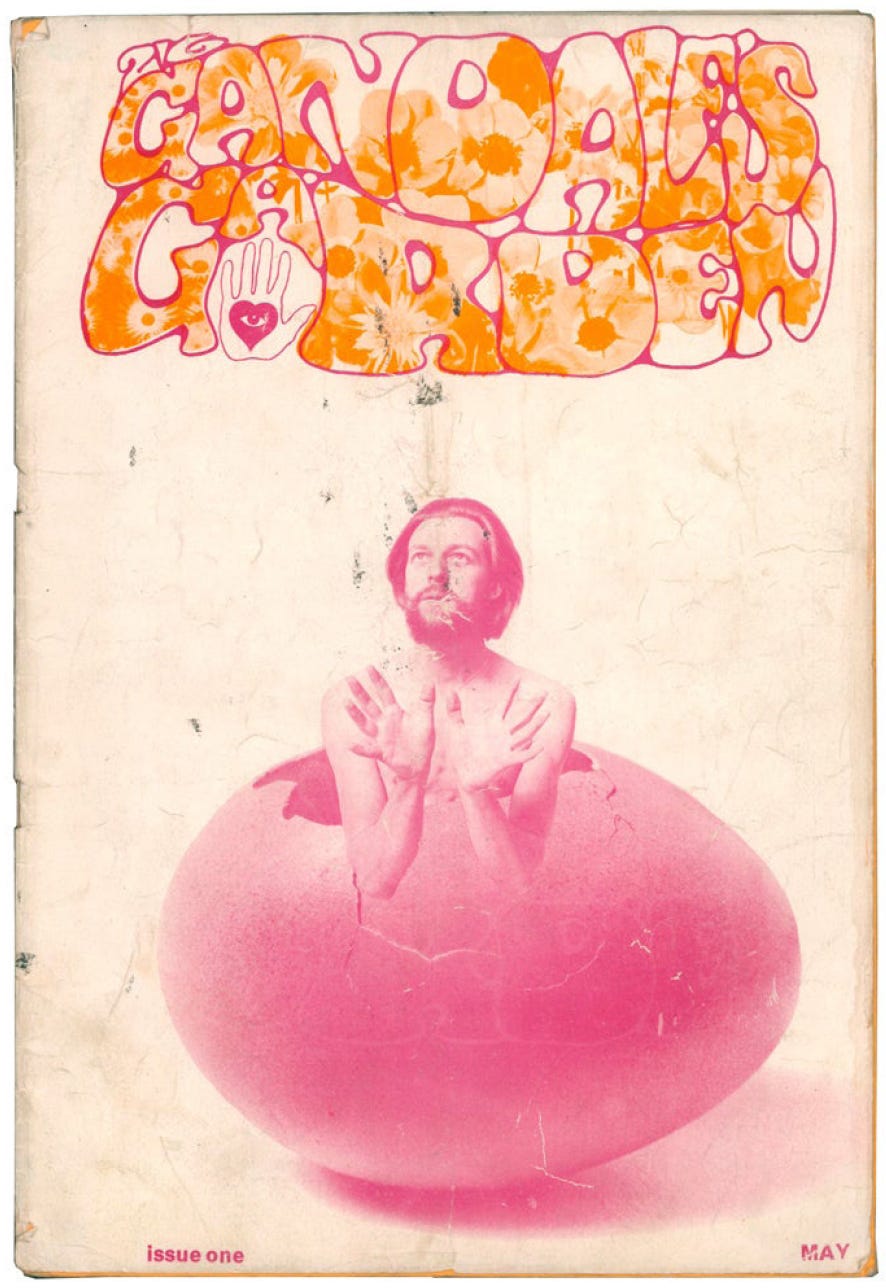
I can’t share designs yet, but can let you know that Gandalf’s Garden magazine below is one of their mood board images.
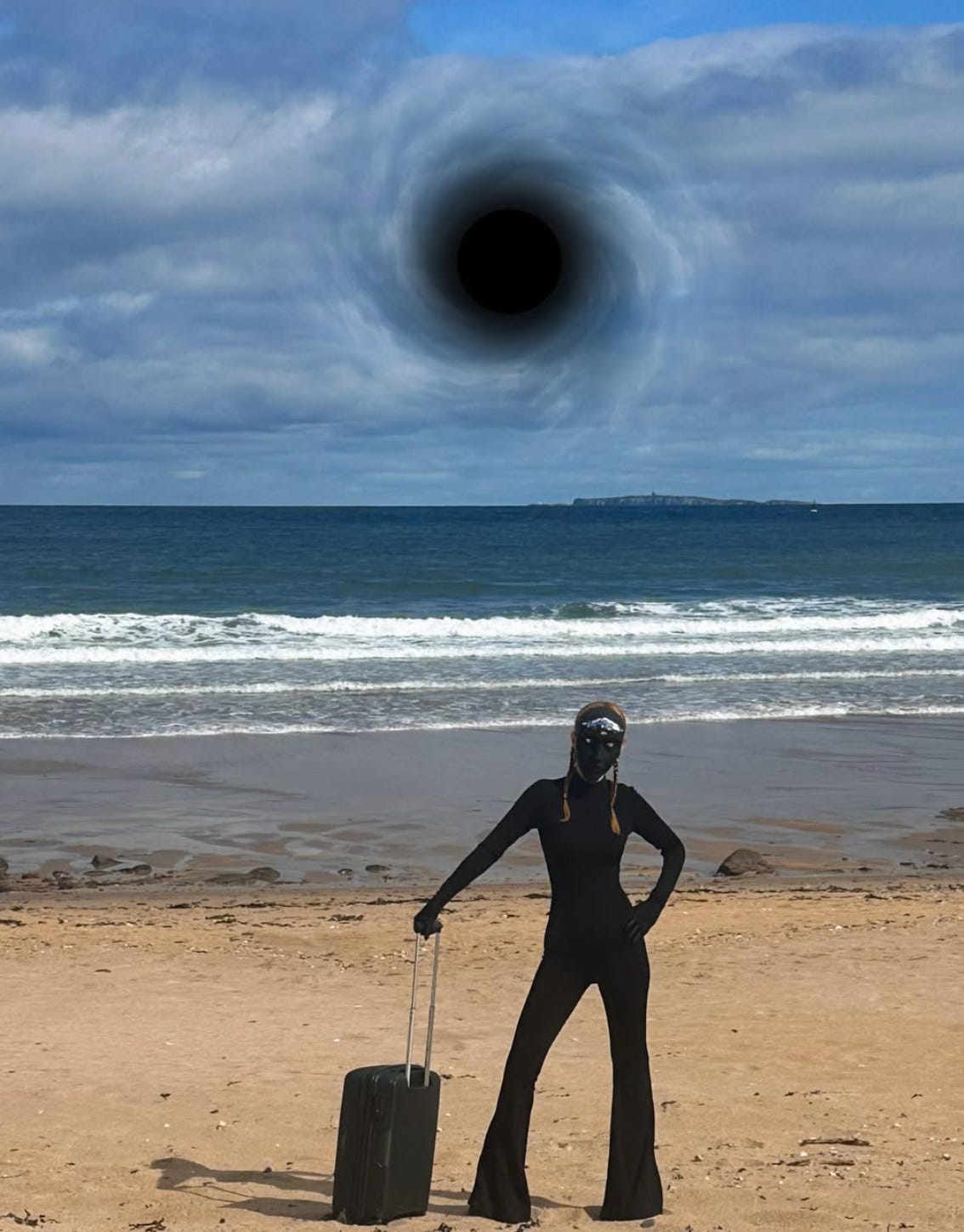
AND, this new edition of Jack and Jill will feature illustrations by Millie Turner.
She gets 55,000 monthly listeners on Spotify but has still found time to draw quite the freakiest artwork imaginable to accompany my long poem of Mid Land softboy fields and tumuli. You’re going to love it.
I first met Millie after The Abyssmass Variety Show a couple of years ago. She didn’t attend, but I gave away free copies of my work Changeling on the evening and she was passed one by a friend. She wrote to say she liked the writing and we stayed in touch.
Give things away, give everything away, you just never know what will happen.
And speaking of The Abyssmass Variety Show, my frequent collaborator, the beautiful neverending story of Will of Margaret and I are planning the next one, to be held on December 6th, somewhere in London. Still venue hunting, but we’re very open to people who want to perform.
Check out WoM’s post here for more info.
From chapter two of Prodigiosa!
Many ago the after-harvest afternoon air was bright light and the light was as easy as afternoon air. This autumn was clear-eyed and buoyant. It felt pure and helped the Abbot feel pure as he stepped out. He was a practical man but the mercantilean fervour just beyond his walls carried a poisonous taste. Yet, still, in the living god of pigs, traders, warnings and entreaties, the Abbot strode to a table he knew well. He found the Tregetour resetting his practiced arrangement, laying three lengths of thick ribbon, blue, green and red, vertically. Around them, on weather-written wood, the showman placed a thin branch of skinned elder, a sheaf of five or six bundled stalks of corn complete with ears and tied around by a seventh stalk, a pewter dish – dull and with a bent rim – for coins, and sat at the back left of the table, a recently woven corn doll, her skirt mid-whirl, corn still fresh enough to feed. The Tregetour stepped back, looked up, gave the Abbot a nod of cognition.
The Abbot had watched the placing with a whittled eye, determined today to unjuggle the secret. He was one of a small crowd now. His robes were plain, his seniority was silent and to the crowd he was an unsexed, early-rising gardner who knew nothing of the real world. Some were amused to see him waiting to watch the show – he’ll believe the mountebank’s tumbling fingers and tumbling words they nudged to each other. If you think the trick has just begun, you’ll always be wrong, jostled into a sense of untrue time without ever knowing it.
The trick began. The Tregetour’s talking was clumsy, awkward. On the first watch, a week prior, it had seemed to the Abbot to be unnecessary, now he wasn’t sure. The Tregetour talked of performing for an important family several counties away, though no one gathered had heard the name before. As he talked of a manor house and hall with many hunted boar heads on the walls and a river of wine and the piety of the children, the Tregetour picked up the sheaf of crop and covered the green ribbon on the right with it. None of the piety of green shewed. The Tregetour waved his elder branch, his Jacob’s Rod he called it, and lifted the sheaf. The green ribbon had been replaced by a length of blue. Following a pointed wand, the crowd’s eyes rippled to where the blue ribbon had been lying, wholly uncovered, on the left. Now they saw it was green. Unimpressed, someone in the crowd wandered away to look at a pig.
The Abbot understood. He had heard decades of mutterings in Chapter Houses, served the shaking penitent, questioned the steadfast sinner, and he knew the miracle of men’s minds. He knew that the man who walked away thought the event he had just witnessed was impossible, yet no more impossible than winter receding or swallows returning. In contrast, the Abbot knew the transubstantiation to be possible and marvelled it could happen in such a rough manner and empty of prayer.
Follow me on Instagram.
Website where I am a poet.
Website where I am a Creative Director.